


Scaling For Africa’s Demanding Valve Market
Updated: Jul 7
In valves, performance and reliability are only part of the equation. Increasingly, lead times, landed cost and project execution capability are becoming the true competitive differentiators - particularly for suppliers servicing the mining and industrial sectors across Africa and further afield. Pipes, Pumps & Valves Africa spoke to Pam du Plessis, Managing Director of Invincible Valves, about the current landscape for valve suppliers in 2026.

Invincible Valves has spent the past few years doing what many local industrial businesses say they want to do - grow beyond South Africa’s borders, expand export markets and invest steadily in equipment, people and training. The company has positioned itself as a supplier of high-quality valves and ancillary equipment, underpinned by a strong track record of service delivery and the ability to adapt solutions to customer requirements.
By no means has this been an easy undertaking, says Du Plessis, who has never been in the business of just selling a valve to a customer. “Our business has always – and always will be – about customer service. We are solutions-based and we make sure that we find solutions for our customers that work.”
As part of its drive to deliver greater value to clients, Invincible Valves has invested heavily in its operations, including the development of a new factory and machine shop in Knights, Germiston. Far from the reconditioning business it started out as, this focused strategy has enabled the company to expand both its service capability and product offering.
Today, Invincible Valves supplies a broad range of locally sourced and imported valves, accessories and ancillary equipment. Its in-house facility includes rubber lining services for valves, pipes, fittings and vessels, alongside a complete service, repair and reconditioning capability for multiple valve types.
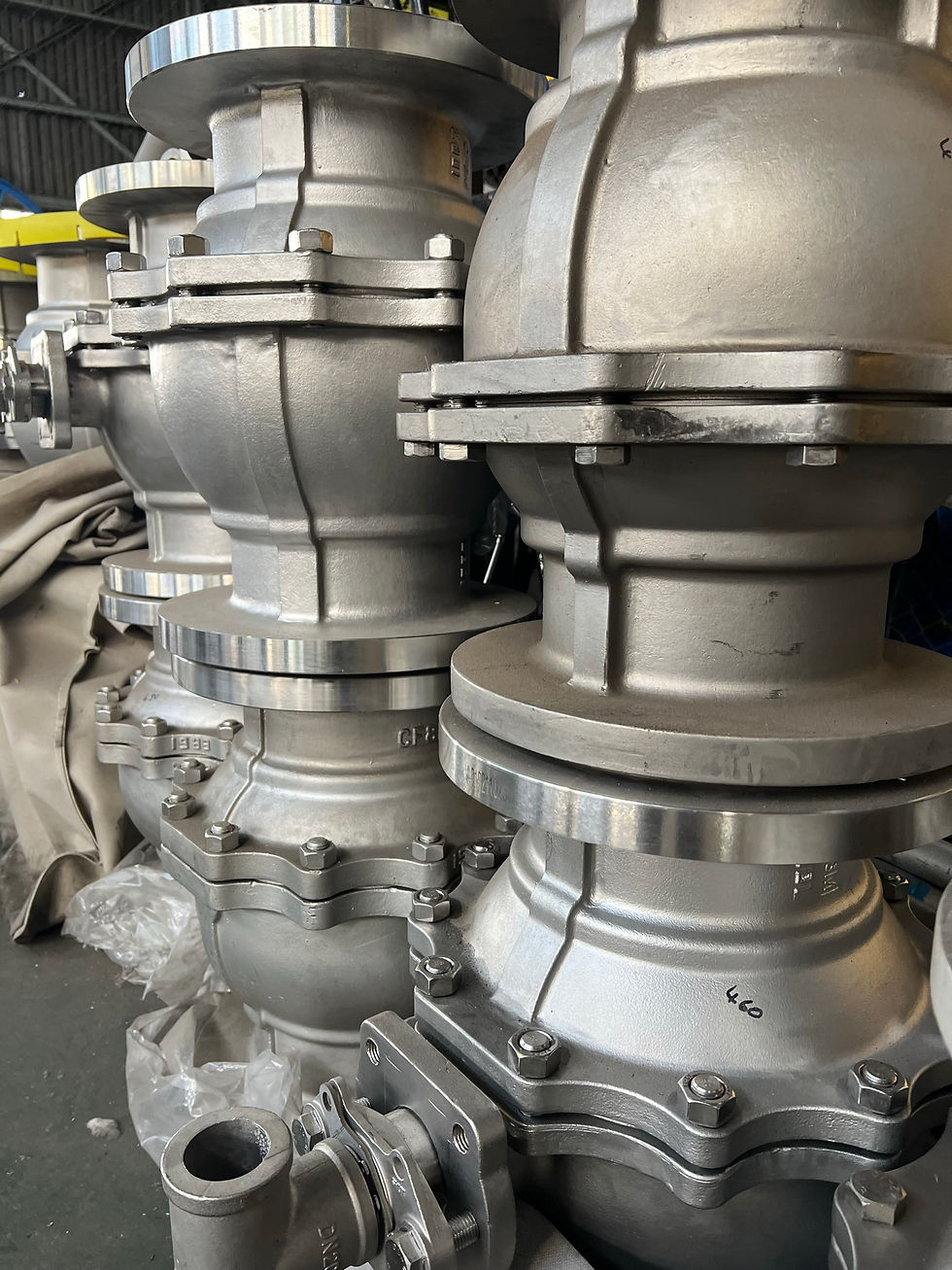
The machine shop supports both valve refurbishment work and specialised manufacturing requirements, while a large autoclave has further expanded capacity, allowing the company to rubber line pipes of up to 10 metres in length, rather than only traditional valves and fittings.
More recently, Invincible Valves has completed the purchase of the building that houses its facilities. “We’ve rented the building for some time and there was some consideration around whether we should stay or move when it became clear we were outgrowing the premises,” says Du Plessis. “But once we made the decision to stay and invest in the factory and the additional facilities, it made sense to take that investment a step further through full ownership of the property.”
She adds that ongoing revamping and upgrading of the buildings - alongside continued investment in equipment - remains a key part of the company’s long-term strategy.
“We see the valve market continuing to grow, particularly in Africa, where we have expanded our footprint significantly. We do a lot of work in the Democratic Republic of the Congo, Zimbabwe, Tanzania and even in Guinea, Sierra Leone and Liberia,” she says. “We’ve built strong relationships in these markets, which are by no means easy to penetrate, and that has helped us establish ourselves as a trusted partner over time.” According to Du Plessis, growing the company’s African business remains a key strategy, particularly as the local market continues to shrink. “We have a dedicated projects team that is renowned for its ability to meet customer requirements quickly and efficiently,” she says. “Our team is able to administer a project from start to finish. Projects range from the supply of new valves to customised valve solutions, including automation on specific sections of a plant. We put a lot of effort into understanding our clients’ needs and making sure we can deliver.”
Changing trends
A major shift she is seeing across the market is that speed of supply has become as important as price. “Lead time has superseded cost,” she says. “People will pay if they can get it quicker.”
Du Plessis explains that where customers once planned shutdowns months in advance, ordering critical valves according to structured maintenance schedules, many operations are now working far more reactively. “We used to get notice of a shutdown, there was a schedule and we could plan around it. But for the past 15 years we haven’t seen that,” she says. “Now it’s a drop of a hat - they need it and they need it now.” That ability to deliver quickly makes all the difference, says Du Plessis. “While we can’t keep everything in stock, we do carry a substantial stockholding to ensure we can service customers with fast turnaround times.”
This has become increasingly important in light of the logistical disruption affecting supply chains globally. “Lead time on the water has gone from around three weeks to as long as seven weeks from China. We’re completely on the back foot and it has become critical to plan properly and anticipate customers’ needs ahead of time.”
Beyond supply constraints, Du Plessis says shifting project trends in mining are also shaping demand. “Depending on the commodity and the mine, many operations still prefer to refurbish,” she explains. “You’ll see plants standing and then restarting, or a section being mothballed while a new shaft is sunk. Technology is also moving all the time — in areas that were mined 10 years ago, operations can suddenly extract far more than before, purely because the technology has improved.”

As a result, she notes, the market continues to see a mix of greenfield activity and revamps. “Open-cast developments and new sections are still coming through, but refurbishment and plant upgrades are not out of the ordinary - they remain a big part of the work.”
Looking ahead
Finding new export markets - and further developing emerging markets such as the United States - remains on the cards for Du Plessis and her team. “We invested a lot of time and effort into the United States and we were making real inroads,” she says. “I spent five weeks there last year working on the market and establishing relationships and we’d already delivered projects.”
However, she notes that sudden shifts in duties and landed cost structures have made pricing far more difficult to manage. “At South African pricing, it’s very lucrative for customers to buy from us,” she says. “But when duties push the price up by 50%, it becomes hard to justify. Something that was $12 000 is suddenly $18 000 by the time it’s cleared and delivered to the customer’s door.”
For Du Plessis, it is the uncertainty that is most challenging. “You can work with a 20% duty, but when it becomes big numbers it starts to feel impossible,” she says. “You don’t want to price yourself out of the market - but you also can’t make commitments when the cost may change again.”
Even so, Du Plessis says the company remains focused on finding practical ways to protect competitiveness while continuing to expand its footprint across Africa and beyond.
Invincible Valves,
+27 (0) 11 822 1777,


Comments